
Create a product with the correct price, stock, and content, and check that the customer can both find and purchase it.
This guide is for store administrators in Go, Plus, and Pro. Basic products, variants, and product groups are available in all three; advanced features have their own plan conditions. Customer login and product watch require Plus/Pro in the current plans. The theme affects display and placement, while purchasability is also controlled by product, group, stock, and customer settings.
1. Create and check the basic product
Open Assortment (Catalogue) → Products → New product and select the intended product type.
Write a clear name, short introduction, and full description in the languages you use.
Enter the correct price, VAT, item number, and image. Distinguish the unit price from the price for a ready-made pack.
Select a product group, inventory management, and any variant. For variant stock, the correct option/variant needs to have a stock balance.
Save and preview. Check both visibility and purchasability, with the correct customer and sub-store.
2. Assess why the product is visible or purchasable
Setting/status | What to check |
Hidden or draft | Intentionally not public; publish/save normally only when the details are complete. |
For display only | Can be displayed without purchase and quantity controls. |
Price is missing | Check the store's option for items without a price or quote; the absence of a price is not automatically an error. |
Out of stock | Distinguish between hide at zero, purchase stop, and allow ordering despite being out of stock. A backorder option can make the item purchasable without a stock balance. |
Variant or group | Check the correct variant's stock balance and the visibility of all regular groups; the primary group is not the only visibility rule. |
Watch product | Plus/Pro and the correct stock/display support are required. Watching is not the same as buying a backordered product. |
3. Field reference and in-depth information
What different types of products are there? There are currently four different types of products: - product (physical or downloadable) - package (consists of several different products) - service - gift card
Product
The most common thing in a store is regular products. Here you can specify various properties such as name, description, price, stock balance, item number, weight, shipping information, and more.
Package
Choose from the product types available in your store. Distinguish the Package product type, which links several products together, from a regular product sold as a ready-made multipack.
A product package must contain at least two products, and you can set a new price for the package itself, completely independent of the base price of the products in the package. Example: If you create a package with three products that cost 50 kr each, you can set a custom package price of 120 kr.
Service
What distinguishes a service from a regular product is that the blocks (properties) for stock balance and shipping, among others, are missing.
Gift card
Gift cards require Plus or Pro in the current plans. Check actual feature availability for older or individual agreements.
If a customer wants to give a gift card, they can use gift cards in the store. The store owner then creates gift cards with different values, for example, 100 kr, 250 kr, 500 kr, etc. The customer can then buy one or more gift cards to give away. They are either sent out via email, or the buyer can print them out and give a physical gift card that works as payment in the store.
Create a new product
Go to Products -> Click the "+ New product..." button in the upper right -> select "New product".
On this page (the "Product properties" tab), there are several different boxes containing various settings.
A copied product is created as a hidden draft. Set the new product's correct details and price before the first normal save. Do not use copying as a way to reset the same item's actual price history. For an advertised price reduction, the relevant previous lowest price and discount calculation must follow the rules. See also background on sale prices and current guidance from the Swedish Consumer Agency.
Texts
This box contains settings for the product's name and descriptions. If you have activated multiple languages, a field for each language will be displayed for each property.
Product name
Enter a name for the product. Keep in mind that this name is important for search engines, so instead of just entering "t-shirt," you should consider including the manufacturer or similar in the name as well. For example, "T-shirt from [brand]".
Introductory text
This field is displayed on the product page just below the product name and is intended for a short summary of the product.
Description
This field is intended to be used for a long, detailed description of the product.
Pricing
This box contains settings for prices, VAT, and the option to activate a quote function. If you have activated multiple currencies and set them to be manual, a field for each manual currency will be displayed for each price field. However, it is most common to have a base currency and then link other currencies to this base currency. The system can then automatically calculate prices in these other currencies based on the current exchange rate.
Regular price
A field for entering a regular price for the product.
Sale price
A field for entering a sale price for the product.
Note that the new pricing system with price lists can also be managed under Products -> Pricing.
VAT rate
If a product should have a different VAT rate than the standard VAT rate, you can specify it here.
Under Settings -> VAT -> VAT rates -> Standard VAT rate for the store's items, you specify a default VAT rate for all products.
Show “Request quote” instead of “Buy” for this item.
In some cases, you may not know what the product will cost and need to get a quote. You can activate this setting on the product. Instead of a buy button, the customer will fill in an email address and mobile number; they also have the option to fill in a name and a message. The customer will then be able to click "Send price request." The information and the item in question will be sent by email to the store owner.
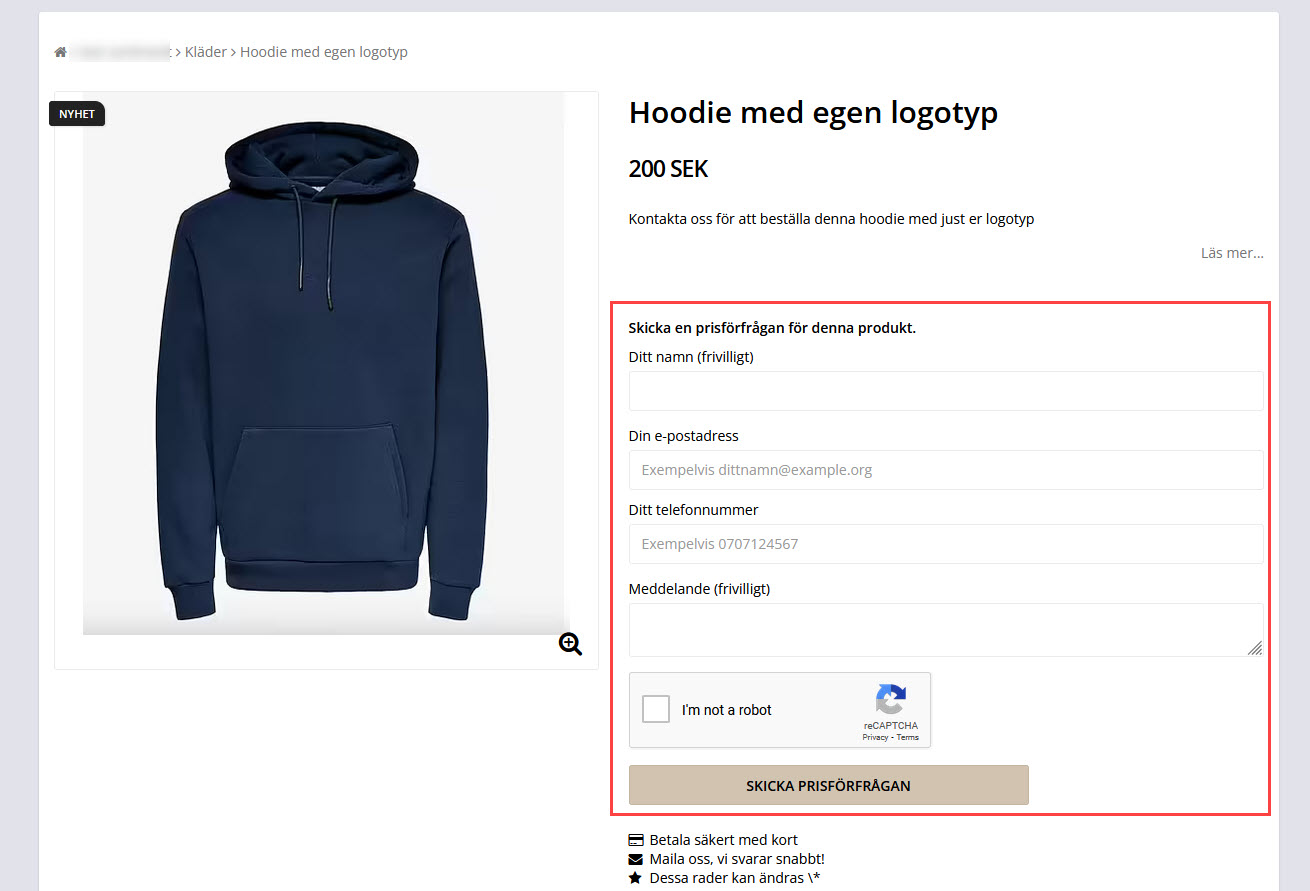
By default, you must enter a price for products to be able to create them. If you want to create products without a price, you can change this setting under Products -> Product settings -> Items without price.
Inventory management
This box contains settings for activating inventory management, setting the stock balance, and displaying various stock messages to the customer.
Enable inventory management
This setting must be activated for inventory management to work.
Stock balance
Field for entering the stock balance.
If you use customer's choice and have activated inventory management, you enter the stock balance for each choice under the "Customer's choice" tab.
Show stock balance
If you want to show the product's stock balance to the customer, activate this setting. The stock balance is displayed on the product page, and if the balance is 0 or less, the stock message from the "Stock message for out-of-stock items" field is displayed instead.
Hide item if out of stock
If you want the product to be hidden when it sells out, you can activate this setting.
Allow orders even if out of stock and show stock message
The backorder setting allows ordering without a positive stock balance when the product is otherwise purchasable. If Hide item if out of stock is also activated, the product is hidden and cannot be purchased at zero stock. Enter a realistic delivery notice in Stock message for out-of-stock items and check the correct variant and other purchase and visibility settings.
Stock message for out-of-stock items
If you have activated inventory management and "Show stock balance," this field will be displayed on the item page. Here you can enter a text that informs when the product is expected to be back in stock, for example, "Temporarily sold out. Back in stock in 3-4 days".
Send me an email at low stock status
A field to activate a setting for the store owner. If you want to be warned that a product is about to run out of stock, you can activate this function. You must then also enter a value in the "Stock warning limit" field, i.e., when the warning should be sent. For example, if you enter "2" in the field, the system will send an email to the store owner (the email is sent to the email address specified under Settings -> Email -> Order emails) when the stock balance becomes two or lower.
Hide product if out of stock
Check the box to hide the product when it runs out of stock.
Stock location name (for sorting in picking list)
Enter the stock location name here.
Properties
Weight and product template are different properties. Enter weight in grams for a physical item and correct shipping handling. Product templates require their feature to be available, including Plus/Pro in the current plans.
Weight
If you use a shipping service like Unifaun and/or Pacsoft, you must enter the weight for all products. The weight should be entered in grams, and it will be summed for all items in the shopping cart to then calculate a shipping fee based on the total weight.
Product template
If you have created product templates, they will be displayed in a list here. Select the template that the product should use. Product templates are created under Products -> Product templates.
Quantity
In this field, you can control how many units of the product must be purchased. By default, you can buy anything from one to as many products as are in stock. But some products you might want to sell in 6-packs, 10-packs, or similar, and you can set that here.
Minimum quantity step
The quantity the customer can order must be a multiple of this number. The default is "1".
First, decide what the price and stock balance refer to. If the product is a ready-made 10-pack and the price is for the entire pack, you normally use Minimum quantity step 1 and Minimum quantity 1; one purchased quantity is then one pack. If the price is instead per piece and the customer must buy in multiples of ten, you enter Minimum quantity step 10 and Minimum quantity 10. Ten items will then cost ten times the price per item. Check that the product name, price, stock balance, and picking list use the same unit.
Minimum quantity
The minimum quantity that can be purchased. The default is "1".
Minimum quantity refers to the quantity of the product to which the price applies. For a pre-packaged 10-pack with a package price, the minimum quantity is normally 1 package. For products priced per item that must be purchased ten at a time, the minimum quantity is 10 items. The field does not convert a package price to a price per item.
Maximum quantity
If you want to limit the quantity of this product that can be purchased, enter the value in this field. The default is "0" for an unlimited quantity.
Hide quantity input field (product view)
If you do not want the customer to be able to choose the quantity of the product, you can enable this setting. The customer can then only purchase the quantity permitted by the store owner's Minimum quantity, Minimum quantity step, and Maximum quantity settings.
Never show quantity input field
The setting above (Hide quantity input field) only applies to the product page. If you do not want the buyer to be able to change the quantity in the cart/checkout, you must also check this box.
Product settings
This field contains settings for the product, such as whether it should be displayed as a new arrival, for display only, etc.
New arrival
If you enable the product as a new arrival, it will be displayed on its own "New arrivals" page. You can also add a product block to the homepage in the theme and select the "New arrivals" connection. Then, only the products marked as new arrivals will be displayed.
Customer-specific file
If you want the buyer to upload an image/file for the product before adding it to the cart, enable this setting. For example, if you sell products with custom prints. The buyer can then easily attach an image to be printed on the product.
Customer-specific file is required
If you have enabled the setting above, "Customer-specific file", you can make this setting mandatory, so that the buyer must upload a file to be able to add the product to the cart. To do so, check this setting.
If only this setting is enabled, nothing will happen. The "Customer-specific file" setting must be enabled for "Customer-specific file is required" to have any effect.
Exclude from related products
The current Go, Plus, and Pro plans include support for related products on the product page. The display also needs to be enabled in the theme or product block you are using. For example, accessories or "Customers also bought". In some cases, you may not want to show certain products in a related products list, and you can then disable them with this setting.
For display only
If you only want to display a product without it being purchasable, you can enable this setting. For example, if it is an upcoming product, you can add it in advance and then make it purchasable when it comes into stock.
Text in order confirmation
A field where you can enter a text for this specific product that will be displayed in the order confirmation.
Note that there is a general field for "Text in order confirmation" under Settings -> Document and email content -> Order confirmation -> Text on order confirmation.
You should only use this field if there is something specific about this particular product that you want to communicate.
Information
This field contains a setting to hide the product and also shows what product type it is.
Hidden
A setting to hide the product. The product will not be displayed in the storefront, only in the admin. In the product list, the product row is also marked in dark gray.
Product type
There are four different product types, and this shows which type it is. Product, package, service, or gift card.
Categorization
Select product groups and, where relevant, the Google product category. Check the product feed's feature availability separately.
Product group
Select which product group(s) the product should belong to.
Membership in multiple product groups is included in the current Go, Plus, and Pro plans. A product has a primary group and can also belong to more groups. Check your store's actual feature availability for older or individual agreements; do not create product copies or change subscriptions just because a group selection is missing. A product group is a categorization; product, package, service, and gift card are different product types.
Google Taxonomy
Google has its own predefined product categorization. Select a correct category when it is needed for the product; do not invent your own Google categories. Google's requirements vary between product categories, so a manually selected category for each product is not a general approval requirement. See the product feed guide for current requirements.
Identification
The identification field contains properties for identifying the product.
Product number
A product number can contain letters, numbers, and some special characters.
Some external systems (shipping systems, accounting and POS systems, etc.) may have limitations and not allow certain special characters in the product number, such as spaces, ampersands (&), hash tags, periods, commas, etc. Therefore, you should not use these special characters in product numbers, but only letters (a-z), numbers (0-9), hyphens (-), and underscores ( _ ).
MPN / SKU (Manufacturer's Part Number)
A field for the manufacturer's product number.
GTIN (Global Trade Item Number)
Enter the actual GTIN assigned to the product by the manufacturer. If a GTIN is missing, do not invent a number or treat the brand as a general substitute. The brand and the manufacturer's MPN may also be required depending on the product; follow the product feed guide.
Images
A module for uploading images of the product. Supported image formats are JPG, PNG, GIF, and WebP.
Choose a sharp product image with a suitable size and proportions; around 1000 × 1000 pixels can be a useful example, not a universal format requirement. The system creates image sizes for different screens. The standard limit for a product image is 10 MB; some accounts have special 50/100 MB options. This is an upload limit for the image, not the store's storage space.
In addition, we re-encode uploaded images to AVIF. However, the format is only used if the browser supports it. It is not possible to upload or import AVIF images.
Attachments
A module for uploading an attachment to the product, for example, a PDF file with technical specifications or similar.
You should not use the attachments feature to sell digital files, such as PDF files or similar. The attachment will be available on the product page for all visitors and can be downloaded without having to purchase the product.
We have a feature for selling downloadable files that you can use to sell digital files.
Shipping
This field contains various shipping settings and the display of delivery messages.
Free shipping
If you want a specific product to have free shipping, you can enable it here. If there are some products with free shipping and others without, the regular shipping fee will be applied to the order.
If all items in the cart have free shipping, no shipping fee will be added to the total.
Bulky
A feature to tag a product as bulky, for example, if you sell products that are physically large but may not weigh much and therefore should not use the standard shipping fee.
Typically, you create a delivery method (Settings -> Shipping and delivery) that can handle bulky products (for example, "In-store pickup") and then you disable bulky products on all other delivery methods.
If the customer has at least one bulky product in the cart, only the delivery method(s) that can handle bulky products will be displayed at checkout.
Delivery information
Under Products -> Delivery information, you can create different delivery templates that display different texts depending on whether a product is in stock or sold out. You can then link the templates to your products. It is possible to tag a delivery template as a "default template", which then activates it as the default for all products. You can then manually change the delivery template or turn it off completely via the settings here.
Show the store's default template for delivery information ("[Template name]")
Show no delivery information
Select a custom product-specific template for delivery information
Store owner's notes
A text field for notes. Only displayed in the admin, not in the storefront.
4. Distinguish between three types of files and check quantities
Public attachment: for example, a PDF with specifications can be downloaded via its public address. Do not put a paid file there.
Paid download: use the downloadable product feature with order/code/validity check. The default limit for that upload is 20 MB, not the same as the product image limit.
Customer-specific file: a file the buyer submits with an order. The requirement only takes effect when the customer file feature itself is also enabled.
For selling in six-packs: a minimum quantity of 6 and a minimum step of 6 yields 6, 12, 18… if other conditions allow it. For ten-packs, the equivalent is 10. If the price is per item, six items will cost six times the price per item; this is not the same as a separate package product with its own package price. Also check the maximum quantity and if the quantity can be changed in the cart.
Quick start
Select type and write name/description.
Enter price/VAT, number, image, group, and stock/variant.
Check public attachment vs. paid download and customer file.
Save and check the correct customer's visibility, quantity, and purchasability.
Subscription and access
Basic products, variants, product groups, multiple group memberships, and related products are available in the current Go, Plus, and Pro plans. Customer login, product watch, product templates, and gift cards are available in Plus/Pro. Choose from the product types available in your store and check older agreements and activated add-ons. Distinguish a regular product sold in a multi-pack from the Package product type.
